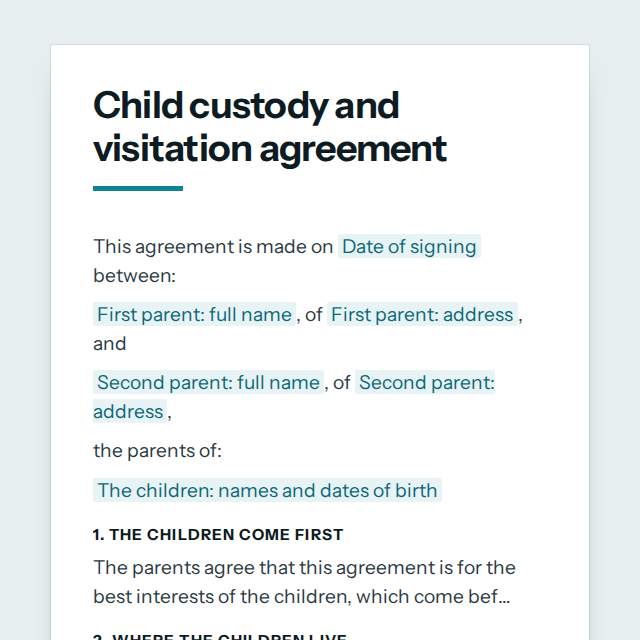
Child custody and visitation agreement
This agreement is made on 20 October 2026 between:
Fatima Al-Hassan, of 14 Palm Avenue, Dubai, United Arab Emirates, and
Omar Al-Hassan, of 8 Marina Walk, Dubai, United Arab Emirates,
the parents of:
- Layla Al-Hassan, born 9 February 2016
- Zayd Al-Hassan, born 21 May 2019
1. The children come first
The parents agree that this agreement is for the best interests of the children, which come before the wishes of either parent. They understand that a court may need to approve it, and that a court may change any term that does not serve a child. They will put the children's safety, health, schooling and happiness before their own disagreements. They will not speak badly of each other to the children or use the children to pass messages or to get back at each other.
2. Where the children live
The children mainly live: with Fatima at 14 Palm Avenue.
3. Decisions
Major decisions about the children's health care, education, faith and long-term activities are Made together by both parents. Everyday decisions are made by the parent who has the children at the time. Each parent will tell the other at once about an emergency, a serious illness or a change of school. In an emergency, the parent who has the children may agree to urgent medical treatment and will tell the other parent as soon as possible.
4. Regular time
The children are with Omar every second weekend from Friday 5 pm to Sunday 6 pm, and every Wednesday from after school until 7 pm.
If a parent cannot look after the children for a whole night or longer during their own time, they will first offer that time to the other parent, as early as they can, before arranging other care. The other parent is free to say no. Time taken up this way does not change the regular schedule or child support, and this rule gives way to a court order and to the children's safety.
5. Holidays and special days
School holidays are shared equally. Eid and birthdays alternate each year. Each parent has the children on their own birthday for two hours.
6. Handovers
At the children's school, or at the main home if there is no school. The parent receiving the children collects them.
The parents will be on time and tell each other as early as they can if they will be late or must change a plan. Time that is missed through lateness or illness is made up by agreement.
7. Safety and wellbeing
No alcohol is drunk by a parent while the children are in their care. Visits are by video call only until both parents agree otherwise.
The parents will listen to the children, in a way that suits their age, and will take their views into account without asking them to choose between their parents. Neither parent will expose the children to violence, abuse or the harmful use of alcohol or drugs. Each parent will introduce a new partner to the children gradually and with care for their feelings, and will tell the other parent before a new partner lives with the children or looks after them alone.
8. Communication
Each child may call or message the other parent at reasonable times. The parents will help them to do so.
The parents will communicate about the children by email or a shared co-parenting app, and by phone for anything urgent.
The parents will keep their messages to each other polite and about the children, and will not discuss adult disputes in front of them.
9. Child support and costs
Omar pays AED 3,000 a month on the first of each month. School fees and medical costs not covered by insurance are shared equally.
Support is a separate matter from visits: one is not withheld because of a problem with the other.
10. Travel and moving
Neither parent moves the children out of the country, or more than 50 km away, without 60 days' written notice and the other parent's consent.
Each parent will keep the passports and documents of the children available for lawful travel that the other parent has agreed to, and will sign any form needed for it.
11. Information and records
Both parents may get information directly from the children's school, doctors and activities, and will keep each other up to date with their address, phone and email.
12. Review, changes and solving problems
Review: Every year in August, and when a child changes school
12.1 The parents may change a part of this plan by agreement in writing (a message is enough for one-off changes). Lasting changes must be in a signed document.
12.2 If they disagree, they will first talk, then try mediation, before going to court. In an emergency either parent may act at once to protect a child. Mediation is not required where there has been violence or abuse, and either parent may go to court at any time where a child's safety or a court deadline needs it.
13. General
This agreement is governed by the law of United Arab Emirates. The parents will ask a court to approve it, where that is needed for it to be enforced.
Court orders or cases about the children: Interim order of the Personal Status Court, Dubai, case 1187 of 2026, dated 3 March 2026
Where a court order about the children is in force, the parents follow it until a court changes it. This agreement lasts until the youngest child is an adult under the governing law, unless a new agreement or a court order replaces it. Each parent pays their own legal costs, unless they agree otherwise or a court orders otherwise. If a part cannot be enforced, the rest stays in effect. Each parent confirms that they signed freely and had the chance to take legal advice.
Signatures
Fatima Al-Hassan
Signature: ______________
Date: ______________
Omar Al-Hassan
Signature: ______________
Date: ______________
Witness or notary, where the law requires one: ______________