Skip to content

Overtime agreement

Agree normal hours, when extra hours can be asked, how they are paid and the limits that protect the employee.

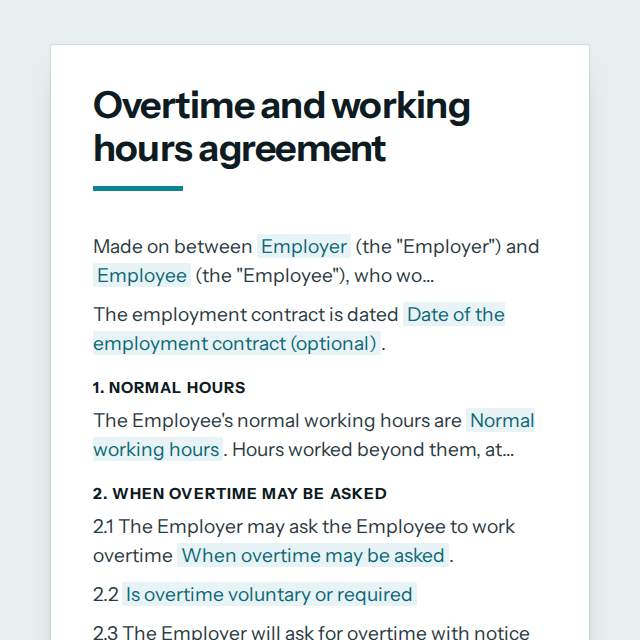
Overtime agreement template, first page

Fill it in and preview

Overtime and working hours agreement

Made on 21 November 2026 between Savanna Foods Ltd (the "Employer") and Kwame Mensah (the "Employee"), who works as Production Line Operator. This agreement is part of the Employee's employment contract.

The employment contract is dated 10 January 2026.

1. Normal hours

The Employee's normal working hours are 40 hours a week, Monday to Friday 7:00 to 15:30, with a 30 minute unpaid break. Hours worked beyond them, at the Employer's request or with its approval, are overtime.

2. When overtime may be asked

2.1 The Employer may ask the Employee to work overtime at seasonal peaks, to finish urgent orders and to cover absent colleagues.

2.2 The Employee must work reasonable overtime when asked, within the limits below.

2.3 The Employer will ask for overtime with notice of at least 48 hours, except in an emergency, and will ask fairly and share overtime reasonably among the staff who can do the work.

2.4 Overtime is worked only when it has been asked for or approved by the Production Manager, in writing or by the staff app. Work done without approval is still paid if the Employer knew of it and allowed it.

2.5 The Employee will not be treated unfairly for refusing overtime where the refusal is reasonable, for example for health, caring duties or safety.

3. Limits

3.1 Overtime is limited to 8 hours a week and 60 hours a quarter, and never more than 48 hours of work in a week on average.

travel to and from work and unpaid breaks does not count as overtime.

3.2 Overtime must never break the legal limits on working time, daily and weekly rest and night work. The Employer will not ask for overtime that would put the Employee's health or safety at risk. The law gives some employees, such as young workers and pregnant workers, extra protection, and the Employer will follow it.

3.3 Where the law lets an employee agree to work beyond them, that agreement is separate from this one, is given freely in writing, and may be withdrawn as the law allows. It is never used where the law does not allow it, for example for young workers. The Employee will not be treated unfairly for not giving it or for withdrawing it.

4. Pay or time off

4.1 Overtime is paid in money.

4.2 The rate is 1.5 times the normal hourly pay on weekdays and 2 times on Sundays and public holidays.

Time off is given at the same rate as the pay would be and taken within 3 months.

4.3 Overtime that is paid in money is paid with the pay for the month in which it was worked, and shown separately on the pay statement.

4.4 Overtime on a rest day, at night, on a public holiday or beyond the daily or weekly limit is paid at least at the rate the law or any collective agreement sets for it, if that is higher than the rate above.

4.5 Overtime is paid on top of the normal pay. It is not included in a fixed salary unless the contract says so clearly and the pay is still above what the law requires for all the hours worked.

4.6 Where the law says so, overtime that the Employee works regularly, whether required or voluntary, counts towards holiday pay and other pay that is worked out from earnings.

Any time off not taken by the last day is paid at the overtime rate.

5. Records

The Employer will keep a record of the hours each employee works, and the Employee will report overtime honestly and on time. The Employee may see the record of their own hours and ask for a correction. Each month the Employer will give the Employee a statement of the overtime worked and how it was settled.

6. Term

6.1 This agreement starts on 1 December 2026 and continues until either party ends it.

It ends in any case on 30 November 2027.

6.2 Either party may end it by written notice, as the law and the employment contract allow. Ending it does not affect overtime already worked, which will still be paid or given back with the final pay.

6.3 The parties will review this agreement once a year, or when the working pattern changes, and may change it in writing.

7. Health and safety

The Employer will check that overtime does not cause tiredness that is dangerous in the job, will give the Employee enough rest before the next shift, and will not ask the Employee to drive or run machinery when unsafe. The Employee will say at once if they are too tired to work safely.

8. General

This agreement adds to the employment contract and does not give the Employee less than the law or any collective agreement. If part of it is not valid, the rest stays in force. A change must be in writing and signed by both parties. A disagreement about hours or pay goes first to the Employee's manager and the HR contact, and then to the court or body that has power under the law of Ghana. The law of Ghana applies.

9. Signatures

Employer (Savanna Foods Ltd): ______________________ Date: ______________

Employee (Kwame Mensah): ______________________ Date: ______________

Templates are a careful starting point, not legal advice. Where the law matters, check what applies where you are.

People and HR

What this template is for

An overtime and working hours agreement you fill in online: normal hours, when overtime is asked, pay or time off, limits and records. Free, Word or PDF.

It is free to fill in online, needs no account, and downloads as a Word document or a PDF. See all People and HR templates

People and HR

What you fill in

The form asks for 19 details. The document fills itself in as you type.

  • Employer

    For example: Savanna Foods Ltd

  • Employee

    For example: Kwame Mensah

  • Job title

    For example: Production Line Operator

  • Date of the employment contract (optional)optional

    For example: 10 January 2026

  • Normal working hours

    For example: 40 hours a week, Monday to Friday 7:00 to 15:30, with a 30 minute unpaid break

  • When overtime may be asked

    For example: at seasonal peaks, to finish urgent orders and to cover absent colleagues

  • Is overtime voluntary or required

    Some countries make overtime voluntary or need the employee's separate consent. Check local law.

    For example: The Employee must work reasonable overtime when asked, within the limits below.

  • Who approves overtime

    For example: the Production Manager, in writing or by the staff app

  • Notice the Employer gives

    For example: at least 48 hours, except in an emergency

  • Most overtime

    It must stay within the legal maximum working time.

    For example: 8 hours a week and 60 hours a quarter, and never more than 48 hours of work in a week on average

  • How overtime is compensated

    Some countries require overtime to be paid in money and do not allow time off instead, for example for most private employers in the United States.

    For example: Overtime is paid in money.

  • Rate

    Never below the legal rate.

    For example: 1.5 times the normal hourly pay on weekdays and 2 times on Sundays and public holidays

  • Rules for time off in return (optional)optional

    For example: Time off is given at the same rate as the pay would be and taken within 3 months.

  • Time that does not count as overtime (optional)optional

    For example: travel to and from work and unpaid breaks

  • Unused time off when the job ends (optional)optional

    Say whether it is paid out or taken before the end. Follow local law.

    For example: Any time off not taken by the last day is paid at the overtime rate.

  • When overtime is paid

    For example: with the pay for the month in which it was worked

  • This agreement starts

    For example: 1 December 2026

  • It ends (optional)optional

    Leave it empty if it continues until ended.

    For example: 30 November 2027

  • Country or state whose law applies

    For example: Ghana

People and HR

What is inside

The parts of this document, in order.

  1. 11. Normal hours
  2. 22. When overtime may be asked
  3. 33. Limits
  4. 44. Pay or time off
  5. 55. Records
  6. 66. Term
  7. 77. Health and safety
  8. 88. General
  9. 99. Signatures

Templates

How it works

  1. 01

    Fill in

    Type your details in the form. The document fills itself in as you type; click any gap to jump to its field.

  2. 02

    Check

    Read it through. Gaps you have not filled stay marked, so nothing goes out half done.

  3. 03

    Download

    Save it as a Word document to edit further, or as a PDF to send or print.

Make it yours with AI

Open it in the chat and ask for changes: shorter, firmer, another situation, another language.

Adapt it with nerix

People and HR

Questions people ask

What details does this template ask for?

The form asks for 19 details, starting with Employer, Employee, Job title, Normal working hours, When overtime may be asked. 5 more are optional.

Can I download this template as Word or PDF?

Yes. When you have filled in the form, save it as a Word document to keep editing, or as a PDF to send or print. It is free and needs no account.

Is what I type sent anywhere?

No. What you type stays in your browser while you fill in the document. It only goes to nerix if you choose to open the template in the chat.

What should I check before I use this template?

Working time law sets maximum weekly hours, rest periods and minimum overtime pay, and an agreement cannot go below them. Agreeing to work more than the legal weekly maximum (an opt-out) is allowed only in a few countries or jobs, and needs a separate, freely given written agreement. Some countries do not allow time off instead of overtime pay, and regular overtime may have to count in holiday pay. Some roles are exempt and some countries need a union or works council to agree. Check local law and any collective agreement.

Are these HR templates free?

Most are. Fill in and download them for free as Word or PDF, with no account. A few longer documents are premium: free to fill in, paid once to download, and marked with their price.

Do the HR templates follow my country's employment law?

They assume no country's law. Employment rules differ a lot, so each template says where to check local requirements before you use it.

Can a small team use them too?

Yes. They work for a team of two or a company of two thousand, and you can cut any section you do not need in the Word version.