Skip to content

Casual work agreement

Hire someone by the hour, with no fixed weekly hours, and set out how shifts are offered and paid.

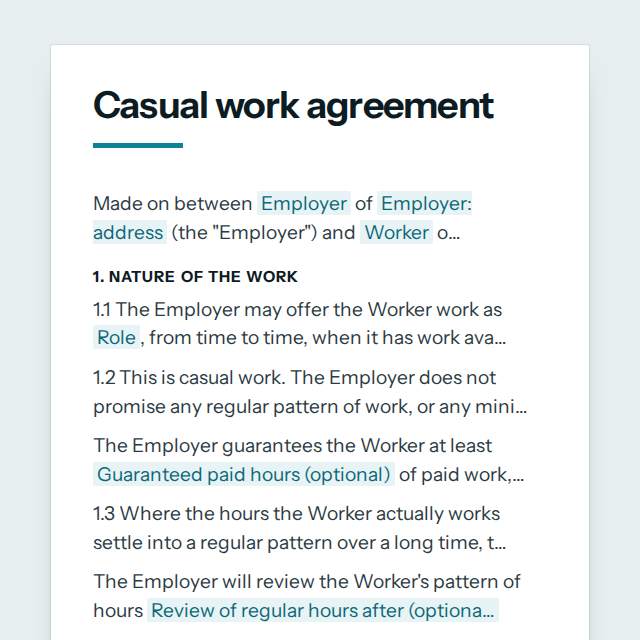
Casual work agreement template, first page

Fill it in and preview

Casual work agreement

Made on 21 November 2026 between Harbour Events Ltd of 88 Wharf Street, Auckland, New Zealand (the "Employer") and Aroha Williams of 14 Karaka Road, Auckland (the "Worker").

1. Nature of the work

1.1 The Employer may offer the Worker work as Event Steward, from time to time, when it has work available. The work involves welcoming guests, checking tickets, helping set up and pack down, and keeping walkways clear. The Worker works at event venues in the Auckland region, named in each shift offer.

1.2 This is casual work. The Employer does not promise any regular pattern of work, or any minimum number of hours beyond a minimum set out in this agreement or required by law, and the Worker does not have to accept an offer. Each accepted shift is a separate engagement, but the Worker is an employee for the time worked, with the rights the law gives, and this agreement does not limit those rights.

The Employer guarantees the Worker at least 8 hours a week of paid work, or pay for those hours if less work is offered.

1.3 Where the hours the Worker actually works settle into a regular pattern over a long time, the parties will review the agreement and, where the law requires, offer the Worker regular hours or a permanent role.

The Employer will review the Worker's pattern of hours every 6 months, and will talk to the Worker about it if the Worker asks.

1.4 The Worker may ask in writing for work with more predictable or guaranteed hours. The Employer will reply in writing, with reasons for any refusal, within one month or any shorter time the law sets, and will not treat the Worker unfairly for asking.

2. Term

This agreement starts on 1 March 2027 and continues until it is ended under section 8.

It ends in any case on 28 February 2028.

3. Offering and accepting shifts

3.1 The Employer will offer shifts only within these days and times: any day of the week, between 07:00 and 23:30.

The Worker's availability: weekday evenings and weekends, not Tuesdays. The Worker may change it at any time by telling the Employer.

3.2 The Employer will offer shifts by text message or the staff app, at least 3 days before the shift where possible, giving the date, times, place and any special requirements.

3.3 The Worker will answer within 24 hours. An offer that is not accepted lapses. The Worker will not be treated unfairly for declining.

3.4 Once the Worker accepts a shift, they will arrive on time and ready to work. If they cannot come, they will tell the Employer as early as they can.

Each shift offered lasts at least 3 hours.

3.5 The Worker may work for others, if it does not conflict with the Employer's business or break the law on working time. The Employer will not stop the Worker from taking other work, except as the law allows.

4. Cancelled and changed shifts

If the Employer cancels or shortens an accepted shift, the Employer will tell the Worker as early as possible and, with less than 24 hours notice, the Employer pays for the first 2 hours of the shift. If the Worker is sent home for a reason that is not their fault, they will be paid as the law requires.

5. Pay

5.1 The Employer will pay the Worker NZD 24.50 an hour, before tax, for every hour worked, including time spent on required training and travel between sites during work. Pay is made every second Friday, for the two weeks before.

Expenses: NZD 0.99 a kilometre for travel between sites, and NZD 5 for a meal on shifts over 8 hours.

5.2 The Employer will deduct tax and social contributions as the law requires, and will give the Worker a pay statement showing the hours, rate and deductions. No other deduction is made unless the law allows it or the Worker agrees in writing.

5.3 Holiday pay: 8 percent of gross pay, added to each pay. The Worker is also entitled to sick pay, public holiday pay and other leave as the law provides.

6. Hours, breaks and safety

6.1 The Employer will keep a record of the hours worked and let the Worker see it, give the breaks and rest the law requires, and provide a safe workplace, training and any protective equipment. The Worker will follow the safety rules and tell the Employer of any hazard or accident.

6.2 The Employer will not offer shifts that would take the Worker over the legal limits on working time, including when the Worker also works for others, and the Worker will tell the Employer about other work that could do so.

6.3 The Employer will not give or withhold shifts as a punishment or because the Worker made a complaint, used a legal right or refused an unsafe task.

7. Conduct, confidentiality, data and property

The Employer will use the Worker's personal data only for the work, pay, tax and its legal duties, and keep it safe. The Worker will act honestly, treat others with respect and follow the Employer's reasonable rules. The Worker will keep private the Employer's business information and the personal details of people they meet at work, and will return all property when the engagement ends.

8. Ending the agreement

Either party may end this agreement by giving 1 week of written notice. The Employer may end it at once for serious misconduct, and the Worker may end it at once if the Employer seriously breaks it. If the Worker is not offered or does not accept any shift for a long time, the Employer may treat the agreement as ended after telling the Worker in writing. Ending the agreement does not affect pay for shifts already worked or holiday pay owed, which will be paid with the final pay.

9. General

This is the whole agreement about the work. A change must be in writing and signed by both parties. Where it gives the Worker less than the law, the law applies and the rest stays in force. The law of New Zealand applies.

10. Signatures

Employer (Harbour Events Ltd): ______________________ Date: ______________

Worker (Aroha Williams): ______________________ Date: ______________

Templates are a careful starting point, not legal advice. Where the law matters, check what applies where you are.

People and HR

What this template is for

A casual employment agreement for zero hours work, you fill in online: how shifts are offered, hourly pay, cancelled shifts and holiday pay. Free, Word or PDF.

It is free to fill in online, needs no account, and downloads as a Word document or a PDF. See all People and HR templates

People and HR

What you fill in

The form asks for 23 details. The document fills itself in as you type.

  • Employer

    For example: Harbour Events Ltd

  • Employer: address

    For example: 88 Wharf Street, Auckland, New Zealand

  • Worker

    For example: Aroha Williams

  • Worker: address

    For example: 14 Karaka Road, Auckland

  • Role

    For example: Event Steward

  • What the work involves

    For example: welcoming guests, checking tickets, helping set up and pack down, and keeping walkways clear

  • Place of work

    One address, or the area and how the place is given for each shift.

    For example: event venues in the Auckland region, named in each shift offer

  • Starts on

    For example: 1 March 2027

  • Ends on (optional)optional

    Leave empty for no end date.

    For example: 28 February 2028

  • How shifts are offered

    How, and how far ahead. Some countries set a minimum notice, and the Worker may refuse a shift offered later.

    For example: by text message or the staff app, at least 3 days before the shift where possible

  • Days and times when shifts may fall

    The days and hours within which work may be offered. Some countries require you to state them.

    For example: any day of the week, between 07:00 and 23:30

  • Time to reply to an offer

    For example: 24 hours

  • Shortest shift (optional)optional

    For example: 3 hours

  • Guaranteed paid hours (optional)optional

    Some countries do not allow zero hours, or treat a set number of hours as agreed if none is stated. Leave it empty for none where the law allows.

    For example: 8 hours a week

  • Availability the Worker has given (optional)optional

    The Worker may change it by telling the Employer. It is not a promise to accept shifts.

    For example: weekday evenings and weekends, not Tuesdays

  • Travel and expenses (optional)optional

    For example: NZD 0.99 a kilometre for travel between sites, and NZD 5 for a meal on shifts over 8 hours

  • Review of regular hours after (optional)optional

    Some countries let long-term casuals ask for regular hours. Check local law.

    For example: every 6 months

  • Pay before tax

    At least the minimum wage that applies. Say the unit, usually an hour.

    For example: NZD 24.50 an hour

  • Pay day

    For example: every second Friday, for the two weeks before

  • If the Employer cancels a shift

    Some places require payment for cancelled shifts. Check local law.

    For example: with less than 24 hours notice, the Employer pays for the first 2 hours of the shift

  • Holiday pay

    It must meet the legal minimum. Some countries allow holiday pay added to each pay only for casual or irregular work.

    For example: 8 percent of gross pay, added to each pay

  • Notice to end the agreement

    For example: 1 week

  • Country or state whose law applies

    For example: New Zealand

People and HR

What is inside

The parts of this document, in order.

  1. 11. Nature of the work
  2. 22. Term
  3. 33. Offering and accepting shifts
  4. 44. Cancelled and changed shifts
  5. 55. Pay
  6. 66. Hours, breaks and safety
  7. 77. Conduct, confidentiality, data and property
  8. 88. Ending the agreement
  9. 99. General
  10. 1010. Signatures

Templates

How it works

  1. 01

    Fill in

    Type your details in the form. The document fills itself in as you type; click any gap to jump to its field.

  2. 02

    Check

    Read it through. Gaps you have not filled stay marked, so nothing goes out half done.

  3. 03

    Download

    Save it as a Word document to edit further, or as a PDF to send or print.

Make it yours with AI

Open it in the chat and ask for changes: shorter, firmer, another situation, another language.

Adapt it with nerix

People and HR

Questions people ask

What details does this template ask for?

The form asks for 23 details, starting with Employer, Employer: address, Worker, Worker: address, Role. 6 more are optional.

Can I download this template as Word or PDF?

Yes. When you have filled in the form, save it as a Word document to keep editing, or as a PDF to send or print. It is free and needs no account.

Is what I type sent anywhere?

No. What you type stays in your browser while you fill in the document. It only goes to nerix if you choose to open the template in the chat.

What should I check before I use this template?

Zero-hours work is banned in some countries and regulated in many others. You may have to guarantee a minimum of paid hours, give a set notice of shifts and let the worker refuse a shift offered later, pay for shifts cancelled late, allow work elsewhere, or offer regular hours or a permanent job after a time. Several countries are changing these rules between 2026 and 2028. Holiday, sick pay and tax also apply. Check local law, and do not use this agreement where zero-hours work is not allowed.

Are these HR templates free?

Most are. Fill in and download them for free as Word or PDF, with no account. A few longer documents are premium: free to fill in, paid once to download, and marked with their price.

Do the HR templates follow my country's employment law?

They assume no country's law. Employment rules differ a lot, so each template says where to check local requirements before you use it.

Can a small team use them too?

Yes. They work for a team of two or a company of two thousand, and you can cut any section you do not need in the Word version.