Skip to content

Emergency preparedness plan

A workplace emergency plan: who does what in a fire or injury, where to meet, who to call, and how to practise.

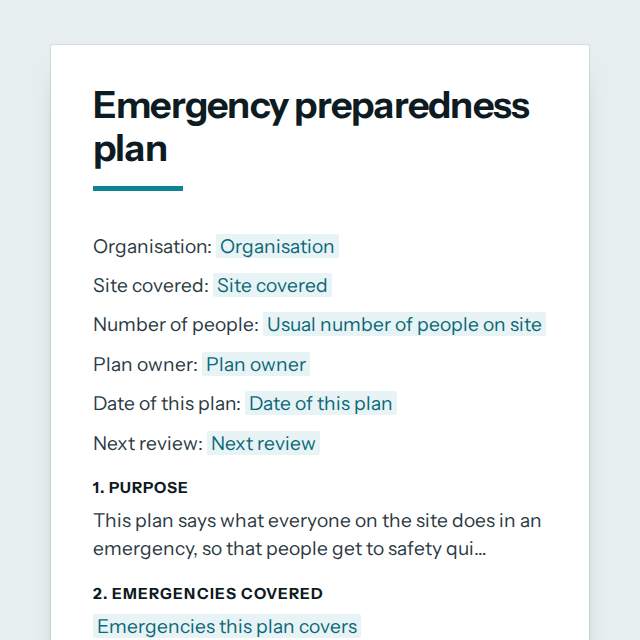
Emergency preparedness plan template, first page

Fill it in and preview

Emergency preparedness plan

Organisation: Nordlys Design Studio
Site covered: Second floor, Storgata 12, Tromsø
Number of people: 35 staff, up to 10 visitors
Plan owner: Ingrid Solberg, office manager
Date of this plan: 9 January 2027
Next review: 9 January 2028

1. Purpose

This plan says what everyone on the site does in an emergency, so that people get to safety quickly and help arrives fast. Everyone working here should know it, and visitors are told the basics when they arrive.

2. Emergencies covered

  • Fire
  • Medical emergency
  • Power cut
  • Gas leak
  • Severe weather
  • Threat or violence

3. First actions in any emergency

  1. Protect yourself and others. Do not take risks.
  2. Raise the alarm: Fire alarm bell. For other emergencies, a message on the office chat and a call to the floor wardens.
  3. Call the emergency services on 112 and give the address, what has happened and how many people are hurt.
  4. Tell the emergency coordinator. The coordinator, or the deputy, decides whether to evacuate or stay inside, and can order an evacuation at any time.
  5. Leave by the nearest safe exit and go to the assembly point. Do not go back for belongings.

4. Evacuation

Assembly point: Car park behind the building, next to the bicycle shed

Exits and routes:
Main stairs to the street, and the fire stairs at the east end. Lifts must not be used in a fire.

Floor wardens check their area as they leave, if it is safe, then report to the coordinator at the assembly point. Everyone is counted there, including visitors and contractors, and anyone missing is reported to the emergency services at once. Nobody re-enters until the emergency services say so.

How people are counted: Wardens use the staff list and the visitor sign-in book on the tablet at reception.

When to stay inside instead of leaving:
Severe storm, chemical release outside or an armed threat nearby: stay inside, close windows and doors, move to the interior meeting room and wait for the coordinator.

People who need help to leave:
Anyone who cannot use stairs is helped by two named buddies and waits at the fire stairs landing for the fire service.

5. Roles

Role Name Deputy Phone
Emergency coordinator Ingrid Solberg Jonas Berg +47 900 00 111
First aider Mari Hansen Per Olsen +47 900 00 222
Fire warden Jonas Berg Silje Moe +47 900 00 333

If a named person is away, the deputy takes the role.

6. Contacts

Who Phone
Building caretaker +47 900 00 444
Electricity company fault line +47 800 00 555
Nearest hospital +47 77 00 00 00

7. Fire

  • Raise the alarm and leave. Close doors behind you if you can do so without delay.
  • Use an extinguisher only if the fire is small, you have been trained and you have a clear way out.
  • Do not use lifts.

8. Medical emergency

  • Call for a first aider and the emergency services.
  • Stay with the person, keep them calm and give first aid only as far as you are trained.
  • Send someone to meet the ambulance at the entrance.

9. Other emergencies

Power cut: stay put, use torches, shut down computers. Gas leak: no switches or flames, open windows if safe, leave and call the gas company. Threat: lock or barricade the door, stay quiet, call the police.

10. After the emergency

The coordinator confirms that everyone is accounted for, checks that the site is safe to use again with the building owner or the authorities, and sends one clear message to staff.

The coordinator sends one message to all staff within an hour. Only the managing director speaks to the press.

11. Safety equipment and shut-offs

Extinguishers by each exit. First aid kits in the kitchen and at reception. Defibrillator at reception.

Where to shut off power, gas and water:
Main electrical board in the basement store, gas valve in the kitchen, water stopcock under the stairs. Only the caretaker or the coordinator shuts them off.

12. Practice and review

Drills and briefings: A full evacuation drill once a year and a short briefing for every new starter

After every drill or real emergency the coordinator records what went well, what did not, and what will change. This plan is reviewed by the date above, and whenever the building, the number of people or the risks change.

13. Records

Keep a note of each drill, each real emergency and every check of the equipment, with the date and the name of the person who did it. New starters and visitors are told the alarm, the exits and the assembly point on their first day.

Templates are a careful starting point, not legal advice. Where the law matters, check what applies where you are.

Operations and quality

What this template is for

An emergency preparedness plan for a workplace: fire, medical emergency, evacuation, roles, contacts and drills. Free emergency plan template, Word or PDF.

It is free to fill in online, needs no account, and downloads as a Word document or a PDF. See all Operations and quality templates

Operations and quality

What you fill in

The form asks for 21 details. The document fills itself in as you type.

  • Organisation

    For example: Nordlys Design Studio

  • Site covered

    For example: Second floor, Storgata 12, Tromsø

  • Date of this plan

    For example: 9 January 2027

  • Next review

    For example: 9 January 2028

  • Plan owner

    For example: Ingrid Solberg, office manager

  • Usual number of people on siteoptional

    For example: 35 staff, up to 10 visitors

  • Emergencies this plan covers

    For example: Fire Medical emergency Power cut Gas leak Severe weather Threat or violence

  • How an emergency is announced

    For example: Fire alarm bell. For other emergencies, a message on the office chat and a call to the floor wardens.

  • Assembly point

    For example: Car park behind the building, next to the bicycle shed

  • Exits and routes

    For example: Main stairs to the street, and the fire stairs at the east end. Lifts must not be used in a fire.

  • Emergency number

    The number for fire, police and ambulance where you are.

    For example: 112

  • Emergency roles

    One row for each role, with a named person and a deputy.

    For example: Emergency coordinator | Ingrid Solberg | Jonas Berg | +47 900 00 111 First aider | Mari Hansen | Per Olsen | +47 900 00 222 Fire warden | Jonas Berg | Silje Moe | +47 900 00 333

  • Emergency contacts

    Services, the building owner and the utilities.

    For example: Building caretaker | +47 900 00 444 Electricity company fault line | +47 800 00 555 Nearest hospital | +47 77 00 00 00

  • When to stay inside instead of leavingoptional

    Emergencies where leaving is more dangerous than staying, and where to go.

    For example: Severe storm, chemical release outside or an armed threat nearby: stay inside, close windows and doors, move to the interior meeting room and wait for the coordinator.

  • How people are counted at the assembly pointoptional

    Name the list used for staff, visitors and contractors.

    For example: Wardens use the staff list and the visitor sign-in book on the tablet at reception.

  • Where to shut off power, gas and wateroptional

    For example: Main electrical board in the basement store, gas valve in the kitchen, water stopcock under the stairs. Only the caretaker or the coordinator shuts them off.

  • Safety equipment and where it isoptional

    For example: Extinguishers by each exit. First aid kits in the kitchen and at reception. Defibrillator at reception.

  • People who need help to leaveoptional

    For example: Anyone who cannot use stairs is helped by two named buddies and waits at the fire stairs landing for the fire service.

  • What to do in the other emergencies listedoptional

    A line or two for each emergency you listed that is not a fire or a medical emergency.

    For example: Power cut: stay put, use torches, shut down computers. Gas leak: no switches or flames, open windows if safe, leave and call the gas company. Threat: lock or barricade the door, stay quiet, call the police.

  • How staff and families are informed afterwardsoptional

    For example: The coordinator sends one message to all staff within an hour. Only the managing director speaks to the press.

  • How often you practise

    For example: A full evacuation drill once a year and a short briefing for every new starter

Operations and quality

What is inside

The parts of this document, in order.

  1. 11. Purpose
  2. 22. Emergencies covered
  3. 33. First actions in any emergency
  4. 44. Evacuation
  5. 55. Roles
  6. 66. Contacts
  7. 77. Fire
  8. 88. Medical emergency
  9. 99. Other emergencies
  10. 1010. After the emergency
  11. 1111. Safety equipment and shut-offs
  12. 1212. Practice and review

Templates

How it works

  1. 01

    Fill in

    Type your details in the form. The document fills itself in as you type; click any gap to jump to its field.

  2. 02

    Check

    Read it through. Gaps you have not filled stay marked, so nothing goes out half done.

  3. 03

    Download

    Save it as a Word document to edit further, or as a PDF to send or print.

Make it yours with AI

Open it in the chat and ask for changes: shorter, firmer, another situation, another language.

Adapt it with nerix

Operations and quality

Questions people ask

What details does this template ask for?

The form asks for 21 details, starting with Organisation, Site covered, Date of this plan, Next review, Plan owner. 8 more are optional.

Can I download this template as Word or PDF?

Yes. When you have filled in the form, save it as a Word document to keep editing, or as a PDF to send or print. It is free and needs no account.

Is what I type sent anywhere?

No. What you type stays in your browser while you fill in the document. It only goes to nerix if you choose to open the template in the chat.

What should I check before I use this template?

Laws on fire safety, first aiders and drills differ by country and building. Check the rules for your premises, and have the plan read by whoever is responsible for health and safety. Suited to offices, schools, shops, health and hospitality sites.

Are these operations templates free?

Most are. Fill in and download them for free as Word or PDF, with no account. A few longer documents are premium: free to fill in, paid once to download, and marked with their price.

Do they meet a standard such as ISO 9001?

They are a practical starting point and certify nothing. Standards and safety laws differ by industry and country, so check what applies to you.

Who should approve a procedure?

The person who owns the process and a manager who can authorise it. The procedure template has fields for both, and for the review date.