Saltar al contenido

Write business emails that get read and answered

Practical rules for clear business emails: subject lines, the first sentence, one ask, tone, follow ups and the cases where a call or a letter is better.

El equipo de nerixPublicado 5 min de lectura

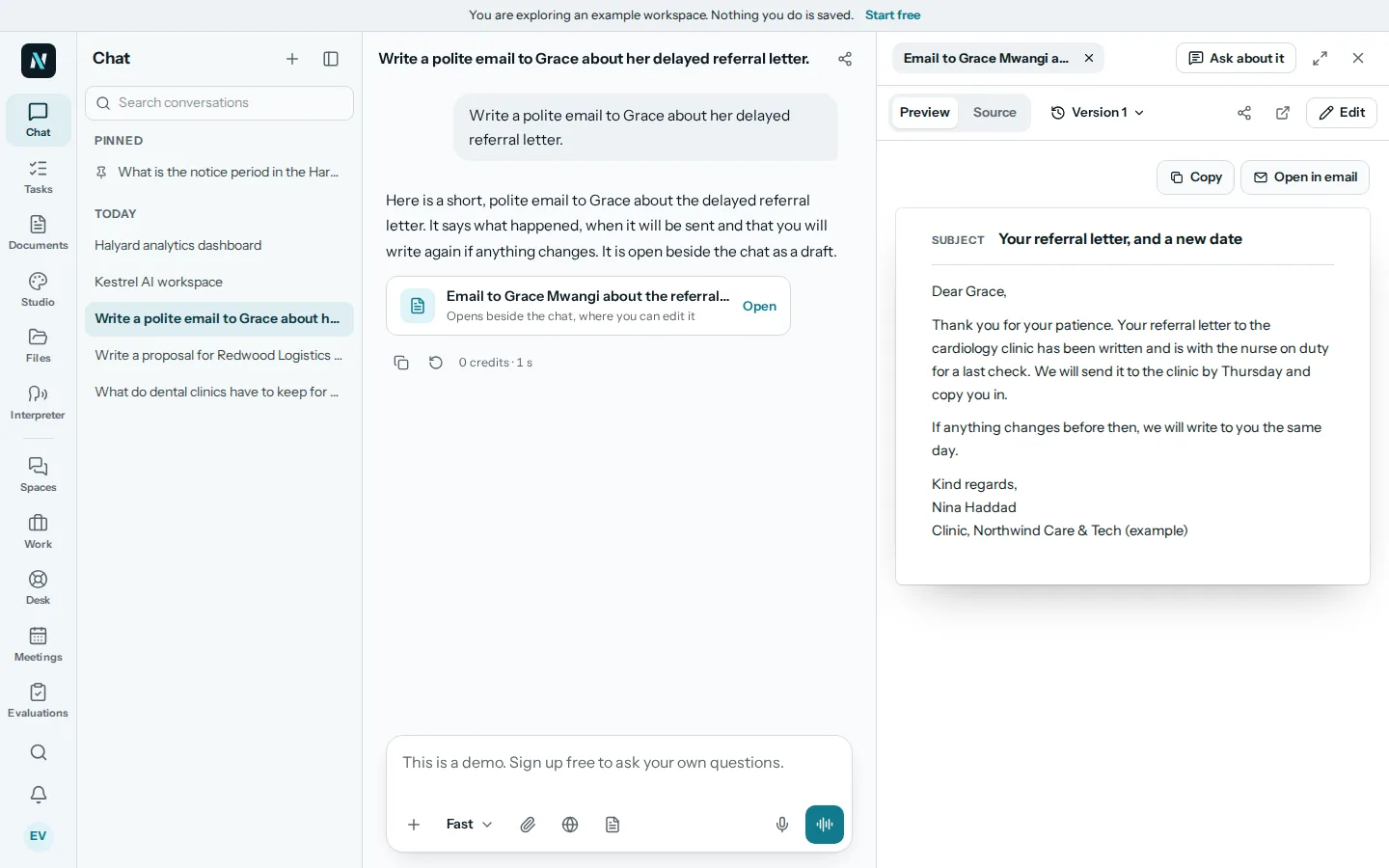
A polite email drafted in nerix chat, with the finished email shown beside it, ready to copy or open in a mail app.
En esta guía

Most of us write emails all day and are rarely taught how. The result is a flood of messages that are too long, too vague or aimed at the wrong person. The reader skims, saves it for later and forgets. If you are the one who needs an answer, that costs you.

Good email is not fancy. It is clear about who it is for, what it says and what you want. Below are the habits that make the most difference when you write business emails that people read and answer.

Know what you want before you write

Finish this sentence: "I want the reader to ___ by ___." Approve the quote by Friday. Tell me which time suits them. Send the missing document. If you cannot finish it, you are not ready to write, and the reader will not know what to do either.

If you want several things, consider whether you need several emails. A message with five questions often gets an answer to the first.

Write a subject line that does the work

The subject line decides whether the email is opened and how it is filed. It should say what the email is about, and, if possible, what you need.

Weak: "Hello", "Question", "Following up". Better: "Quote 1182: please confirm by Friday 14 March", "Meeting request: 30 minutes on the new menu", "Missing: signed delivery note for order 551".

Put the key word first and keep it short enough to read on a phone. Change the subject when the topic changes, so the thread stays findable.

Open with the point

Do not make the reader dig. The first sentence says why you are writing and what you need. Context comes after.

Weak: "I hope you are well. I wanted to touch base regarding the thing we spoke about last month and see whether there have been any developments." Better: "Could you confirm by Friday whether you would like the larger table? It affects the order I place with the carpenter on Monday."

A short greeting is polite. A paragraph of pleasantries before the ask is not.

One email, one main ask

State the ask plainly, make it easy to answer and give a date if there is one. "Please reply with yes or no" is easier than "let me know your thoughts". If you need a choice, offer options: "Would Tuesday at 10 or Thursday at 14 suit you?"

If you ask the reader to do something, say what exactly and by when. If something is optional, say so.

Keep it short and easy to scan

Short paragraphs, plain words, one idea each. Use a list when you have steps or items, and bold sparingly for a date or an amount that must not be missed. Cut anything that does not help the reader to act. Read it on a phone: if it is a wall of text, trim it.

Put attachments where they are useful, name them clearly ("Quote 1182 Green Valley.pdf") and mention them in the text. Check you attached them.

Choose the right tone

Match the relationship and the situation. With a new contact, be courteous and direct. With a colleague you know well, be friendlier. When delivering bad news, be clear, kind and brief. When a matter is serious or tense, avoid sarcasm, capital letters and exclamation marks, which are easy to misread in writing.

Read it as the recipient would. Would you be happy to receive it? If you are angry, write it, leave it and rewrite it the next day.
Use To, Cc and Reply all with care

Put the person who must act in To. Use Cc for people who need to know, and mention why. Do not copy a manager to pressure someone. Think before using Reply all: does everyone need this? When you add someone to a thread, say who they are and why.

Common types and what they need

An introduction. Say who you are, how you found them, why you are writing and a small, specific ask. Our introduction email template has the structure.

A meeting request. Say the purpose, the length, the options for time and how to reply. The meeting request email template is built that way.

An out of office reply. Say the dates, whom to contact instead and what happens to the message. See the out of office reply template.

A follow up. Short, polite and helpful: "Following up on my email of 4 March below. A yes or no on the larger table by Friday would help, as I order on Monday." Do not make the reader scroll to understand it, and do not say "per my last email".

Check before you send

A quick check catches most embarrassments:

  1. Is the right person in To, and no one wrong in Cc?
  2. Is the ask clear and does it have a date?
  3. Are names, numbers and dates correct?
  4. Is the attachment there and the right one?
  5. Would I be comfortable if this were read out in a meeting?

For anything important or sensitive, wait a few minutes before sending. Many errors are found on the second read.

Know when not to email

Email is poor for complicated disagreements, emotional topics, quick back and forth and anything that needs tone. A call is better for those, followed by a short email that records what was agreed. It is also poor for urgent things: if it is urgent, phone.

Keep records tidy

Important emails are part of your records. File decisions, approvals and agreements with the project or customer they belong to, and keep the thread together. A short summary email after a call ("As agreed today: ...") is a habit that prevents many disputes.

Where nerix helps

Email drafts (early access) writes an email or a reply from a few words, or from the one you received. The draft opens beside the chat with To, Subject and the message, and every field can be edited in place. One click makes it shorter, warmer or firmer, or translates it, and each change is kept as a version. Where nerix could not know a fact, such as a date, it leaves a blank in double braces and counts them, and it will not send an email that still has one. Nothing is sent until you press Send.

In the chat, you can paste a long thread and ask for a two sentence summary and a suggested reply. You still check the facts and decide what to say.

The short version

Know what you want and by when. Use a subject line that says it. Open with the point, ask one clear thing and keep it short. Choose the tone for the person, check the details and call when email is the wrong tool.

Preguntas frecuentes

How long should a business email be?
As short as it can be while still giving the reader what they need to act. For most requests that is under 150 words. If it needs more, use headings or a short list, or attach a document.
When should I follow up on an email with no reply?
After two or three working days for something routine, sooner if there is a deadline. Keep the follow up short, refer to the first email and make the ask easy to answer.

Compartir esta guía

Plantillas para esto

Rellena una en línea y descárgala en Word o PDF. Gratis, sin cuenta, y lo que escribes se queda en tu navegador.

En nerix

Pruébalo con tu propio trabajo.

nerix redacta el primer borrador, responde a partir de tus documentos indicando la página de la que sale cada frase, y reúne el trabajo del equipo en un solo lugar. Empieza con el plan gratuito.

Sigue leyendo