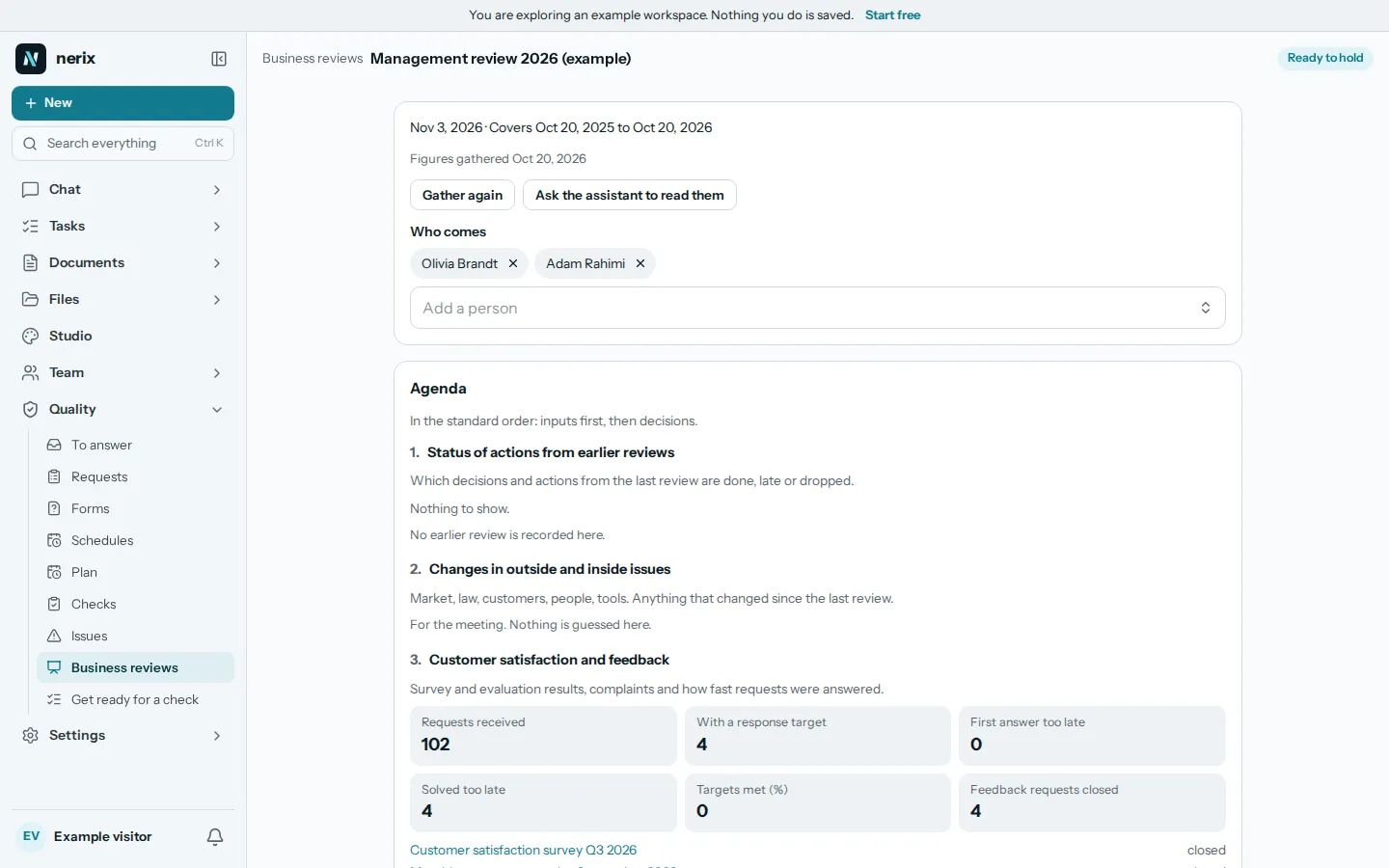
Once a year, or better once a quarter, a business should stop and look at itself. Not at the day's problems, but at the whole picture: Are we meeting our goals? What do customers say? Are our own rules working? What went wrong and why? What do we change?
This is a management review. Standards such as ISO 9001 and ISO 27001 require one, but you do not need a certificate to benefit. For a small business it can be a single focused afternoon, if the preparation is done beforehand.
Why bother
Day to day work is full of urgent things. Important things, such as a customer complaint that keeps coming back or a supplier who is getting worse, never feel urgent until they hurt. A review forces them onto the table with facts. It also gives you a record of decisions, which is useful for new managers, auditors, banks and investors.
Choose a few questions
A good review answers a small number of questions. A common set:
- Goals. Did we do what we set out to do last period? Where did we fall short?
- Customers. What are they telling us: satisfaction, complaints, repeat business?
- Quality and problems. What went wrong, how often and did the fixes work?
- Audits and checks. What did our internal checks find, and are the actions done?
- Suppliers. Are the ones we depend on performing?
- People. Do we have the skills and capacity? How is morale?
- Risks and changes. What has changed in our market, laws and tools? What could hurt us next year?
- Resources. What do we need to do next year's goals?
- Improvements. What are our best opportunities?
You do not need all of them every time, but cover each at least once a year.
Gather the facts beforehand
The meeting is not the place to collect data. A week before, ask each owner for a one page summary of their area: the key numbers, what changed, what went well, what did not and what they propose. Keep the same format each time so that you can compare over time.
Useful facts, each from your own records:
- sales and margins against the plan,
- complaints, returns and corrective actions: number, causes, status,
- on time delivery and error rates,
- audit findings and how many are closed,
- supplier issues,
- staff survey results, turnover and training done,
- decisions from the last review and whether they were carried out.
Do not invent numbers or use ones you cannot back up. Say "we do not measure this" where that is the truth, and decide whether you should.
Put the summaries into one short pack and send it two days before. Ask everyone to read it. If the meeting begins with reading, you have lost the afternoon.
Run the afternoon
Two to three hours is plenty. A simple agenda:
- Last time (10 minutes). What did we decide and what happened?
- The pack, area by area (60 to 90 minutes). Each owner gives two minutes on the key points, then the group discusses. Ask what is surprising, what is getting worse and what is the cause.
- Risks and changes (20 minutes).
- Decisions (30 minutes). Move from discussion to actions.
- Close (10 minutes). Read back the decisions and who owns them.
The chair keeps time, keeps people on facts and asks "so what do we do about it?". Disagreement is welcome. Blame is not.
Decide, don't just discuss
The product of the review is a short list of decisions, each with an owner and a date. Examples:
- Change the supplier for packaging by 30 June, owner: Dana.
- Add a second check to invoicing from next month, owner: Omar.
- Hire one person for customer support in the third quarter, owner: the managing director.
- Drop the lowest margin product line by the end of the quarter.
Aim for a handful. Five decisions done are better than twenty forgotten. Include resource decisions: money, time and people.