Project management has a reputation for paperwork: Gantt charts, status reports, meetings about meetings. For a small team, most of that is overhead. What you need is smaller: everyone knows what matters this week, who owns each piece, when it is due, and what is stuck. This guide describes a light approach that works for teams of two to twenty.
What a project actually needs
Strip it back and a project needs five things:
- A goal in one sentence, stating what is true when it is finished.
- A list of the steps, broken down until each one is a task a single person can finish.
- An owner for each task. One name, not a team.
- A date for each task, even a rough one.
- A place everybody looks, where the current state is visible without asking.
Everything else is optional until you feel the pain it solves. If you can answer "what is this project for, what are we doing next, who is doing it, and when?" in ten seconds, you are managing it well.
Write the goal and the edges
Before listing tasks, write two short things.
The goal. "The new price list is live on the website and sent to all customers by 30 November." Not "improve pricing". A goal you can check is a goal you can finish.
What is not included. Projects grow in the dark. A list of what you are deliberately not doing stops the quiet addition of extras. If the project is for a client, this belongs in a written scope. Our statement of work template and project proposal template give that shape.
Break it down until it is small
A task such as "launch the campaign" is not a task. It is a project. A good task is something one person can start and finish, usually within a few days, and everyone could tell whether it is done.
A useful test: could someone else look at the task title and know what to do? "Write the three product descriptions for the price list" passes. "Content" does not.
Break work down as far as you can still keep track of it. For most projects, ten to thirty tasks is plenty. If you have two hundred, you have gone too deep, or you are managing several projects as one.
One owner, one date
Two rules, and they do most of the work.
One owner. When two people are responsible, neither is. If a task needs two people, give it to one of them and name the other as a helper in the comments. The owner is not necessarily the one who does everything. They are the one who makes sure it happens.
One date. A task without a date will slide. The date does not have to be perfect, but it has to exist, because it is what lets you see what is late. When a date has to change, change it where everyone can see, and say why.
Pick the right view
The same set of tasks can be seen in different ways, and each answers a different question.
- List: what do I do today? Good for personal planning, sorted by date or priority.
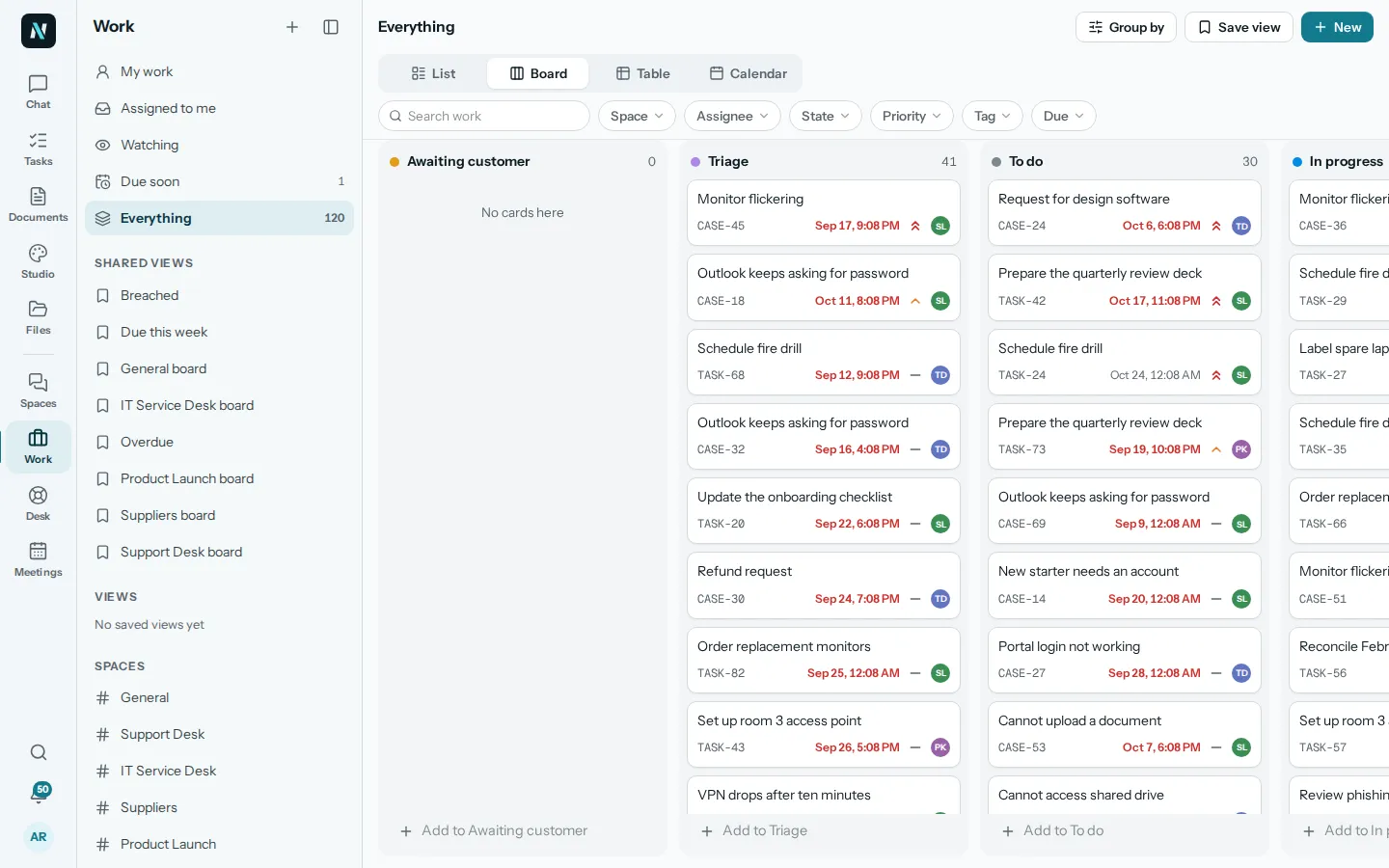
- Board: where is everything in the process? Columns such as To do, In progress, Waiting and Done show the flow and show where work piles up.
- Table: compare many items by their details: owner, date, priority, tags. Good for planning and clean-ups.
- Calendar: what is due when? Good for anything with deadlines or for spotting a crowded week.
In nerix, Work offers all four on the same items, so you do not have to maintain separate lists. You can also save a view, such as "due this week" or "assigned to me", and come back to it. States can be named to fit the way your team works: the defaults run from Triage and To do through Doing and Waiting to Done.