Gå til innhold

Anonymous team surveys that get honest answers

How to design, send and act on an anonymous survey so people tell the truth: good questions, real anonymity, small team traps and what to do with results.

nerix-teametPublisert 5 min lesetid

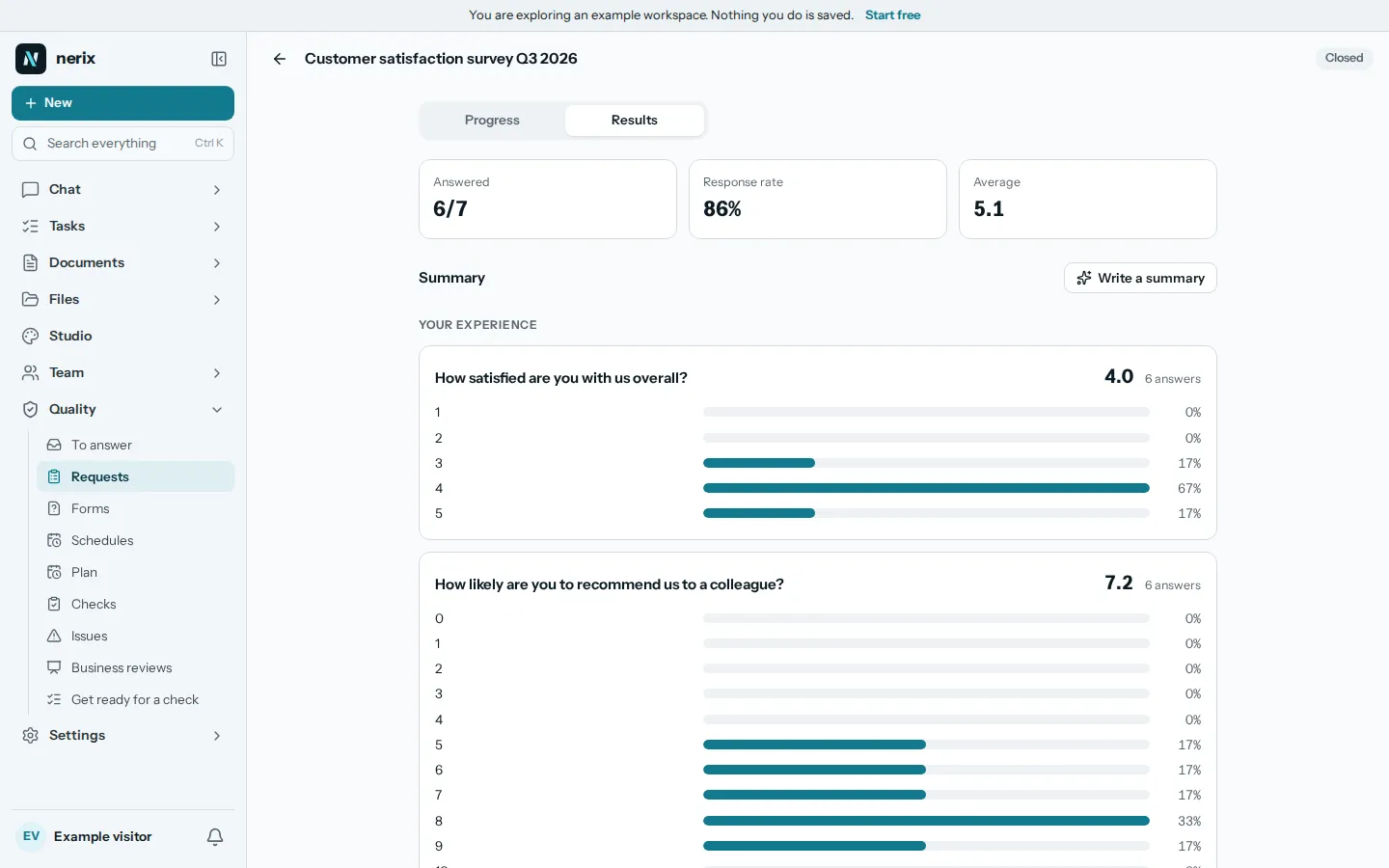
Survey results in nerix Feedback, with the response rate and how people answered each question.
I denne guiden

If you ask your team how things are and get "fine, thanks", you have learned very little. People protect themselves. They worry that honesty will cost them, or that nothing will change, so they say what is safe. An anonymous survey can open that door, but only if people believe it is anonymous, the questions are good and something happens afterwards.

This guide covers each of those three, with attention to the problems of small teams, where anonymity is fragile.

Decide what you want to learn

A survey with no purpose becomes a pile of numbers. Choose one topic: how people feel about workload, how well the team communicates, how meetings are going, how new people are welcomed, what gets in the way. Write the decision it will inform. "We will use this to decide whether to change how we plan the week."

Keep it short. Five to ten questions that take five minutes get more answers and more honest ones than forty questions that take half an hour.

Write questions people can answer

A few rules make a big difference.

  1. One question, one idea. "Are our meetings useful and well organised?" asks two things. Split it.
  2. Concrete over abstract. "In the last month, how often did you leave a meeting unsure what to do next?" beats "How is communication?".
  3. Balanced scales with labels. A rating from 1 to 5 where each end is named ("never" to "always") is easier to answer than a bare number.
  4. Not leading. "How great was the new schedule?" invites a polite yes. "How has the new schedule changed your week?" invites a truthful one.
  5. A few open questions. "What is one thing we should stop doing?" and "What is one thing we should keep?" give you the reasons behind the numbers.
  6. A way out. Let people skip any question. Forced answers get false ones.

Ask about things the team can change. A question on pay may be fine, but only if you are willing to talk about it.

Make anonymity real

People can tell when anonymity is a promise and when it is a design. For it to be real:

  • Do not collect names, emails or any detail that identifies the person. Be careful with questions on role, team, age or length of service: the answers together can point to one person.
  • Do not show results until enough people have answered. A threshold of three answers is a minimum; a larger team can use more.
  • Do not split results by group unless every group is big enough. A result for "the two people in design" is not anonymous.
  • Read open answers with care. A comment that mentions a specific event can reveal its writer. You can group comments into themes rather than quoting every one.
  • Never try to find out who wrote something. Ever. If you do, the next survey will be worthless.

Say all of this at the start, in plain words: who sees what, what is collected, when results are shown. And keep the promise.

For a very small team, consider whether a survey is the right tool. With five people, a conversation in a trusted setting, or a facilitated one, may do more than a form.

Timing and sending

Pick a moment that is not the busiest week. Give people at least a week to answer, and a reminder in the middle. Tell the team why you are asking, how long it takes and when they will see results. Reminders go to everyone who has not answered, without saying who that is.

Do not ask people to complete the survey while a manager stands nearby. Let them do it on their own time, within working hours.
Share the results quickly

Within two weeks, share what you found, including what is unflattering. Do not argue with it in the first meeting. Start by thanking people, show the results simply (the averages, the spread and the themes in comments), and say what surprised you.

Then ask the team what they make of it. Often the explanation is something you could not have guessed.

Choose two or three actions

The point of a survey is change. Do not promise to fix everything. Pick two or three things that matter most and that you can do in the next quarter, say who owns each and when you will report back. Write them down and tell the team. Our follow up after a meeting template is a clean format for this.

Some answers need patience. Say so honestly: "We cannot change pay this year, here is what we can do about workload."

Run the next survey on the same questions, so you can see whether the actions helped. Keep a trend, not just a score.

Avoid the usual mistakes

  • Asking and not telling. Silence after a survey is worse than no survey.
  • Punishing honesty. Even a small sign of irritation spreads quickly.
  • Surveying too often. If every month nothing changes, answers drop.
  • Over reading small differences. A move from 3.8 to 3.9 in a team of six means nothing.
  • Mixing it with performance data. The moment people think answers feed their review, honesty ends.

Where nerix helps

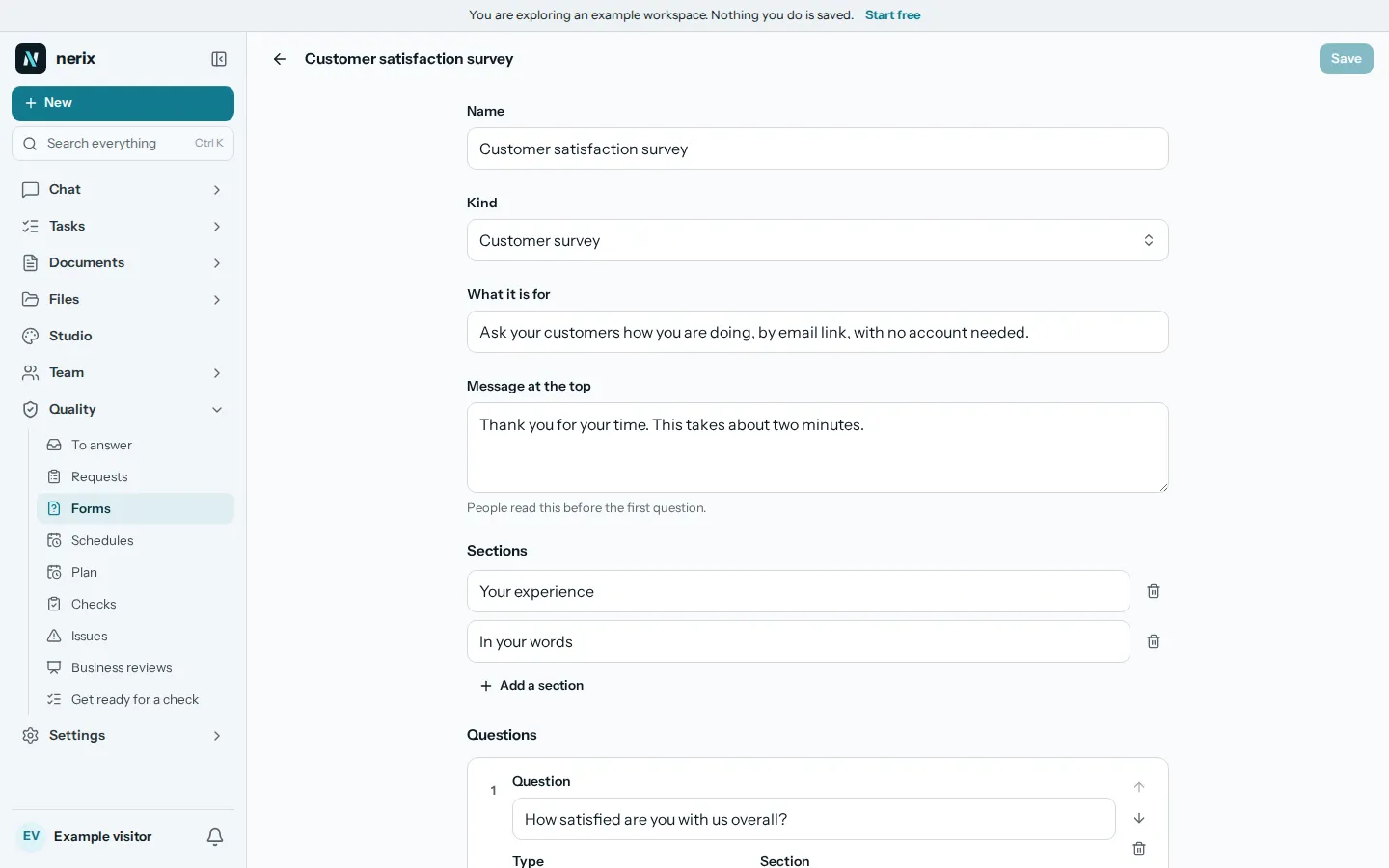
Feedback (early access) includes a team pulse, a weekly check in, a meeting feedback form and a customer survey among twelve starting forms. You copy one, change any question and send each person their own link by email. In an anonymous request an answer is saved with no link to the person and its time is cut to the day, and nothing is shown until at least three people have answered. When answers are split by group, the split appears only if every group is big enough. Reminders can go to the people who have not answered.

When the round closes, you see how many answered, the average per question and the answers, and you can ask nerix for a short summary of themes, strengths and what to work on. It says that it is AI work and reads only what the results page may show, so an anonymous request stays anonymous.

Turn the actions into tasks with owners in Work. In the chat, you can ask nerix to suggest neutral wording for a question you fear is leading.

The short version

Choose one topic and keep it short. Write concrete, balanced questions. Make anonymity real and say how. Share results fast, pick two or three actions with owners and ask the same questions again later.

Spørsmål folk stiller

Can a survey really be anonymous in a team of eight?
It is harder, because people can guess from the details. Ask fewer open questions about specific events, show results only when enough people have answered, and never split answers into groups so small that one person stands out.
How often should I run a team survey?
A short pulse every month or quarter works better than a long yearly survey. Run it only as often as you can act on the answers.

Del denne guiden

Maler til dette

Fyll ut en på nett og last den ned som Word eller PDF. Gratis, uten konto, og det du skriver blir i nettleseren din.

I nerix

Prøv det på ditt eget arbeid.

nerix skriver det første utkastet, svarer fra dokumentene dine med siden hver setning kom fra, og samler teamets arbeid på ett sted. Start med gratisabonnementet.

Les videre