Ugrás a tartalomra

How to run a performance review people trust

A practical way to run fair, useful performance reviews in a small team: what to ask, how to collect it, how to talk about it and what to do afterwards.

A nerix csapataMegjelent 5 perc olvasás

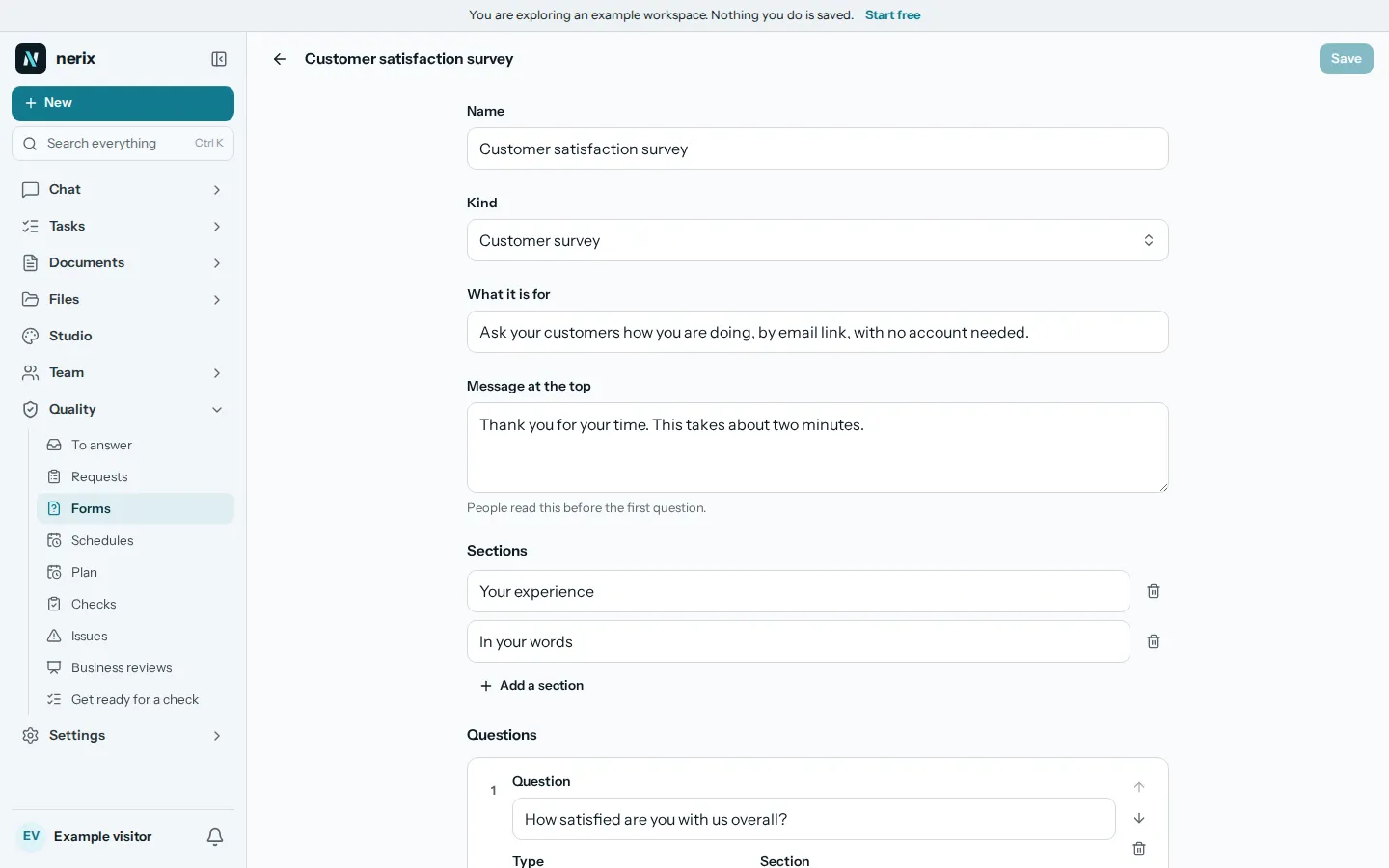
The form editor in nerix Feedback, with the name, the kind of review, sections and questions.
Ebben az útmutatóban

A performance review is a promise: the company will take an hour to think about you properly. When it is done well, people leave knowing what they do well, what to work on and what happens next. When it is done badly, it is a form, a rating nobody believes and a quiet loss of trust.

Small teams have an advantage. You know each other, so a review can be short and honest. What you need is a simple shape that you repeat, so it is fair from person to person.

Decide what the review is for

Pick one main purpose, and say it to everyone beforehand. Common purposes are to help the person grow, to agree on goals for the next period, to recognise good work and to decide pay or promotion. These pull in different directions. A review that tries to do everything in one hour usually does none of it well.

A workable split for a small team: a development review once or twice a year, a light monthly check in, and a separate conversation about pay. Tell people which is which.

Write down what good looks like

People cannot be fairly judged against something nobody wrote down. For each role, list four to six things that matter, in plain words, with an example of good work for each. "Handles customer complaints calmly and fixes the cause" is better than "good communication".

Share the list at the start of the period, not at the end. If you have job descriptions, use them; if you do not, write the list together in the first month.

Collect before you talk

Good reviews are mostly prepared. Gather, for each person:

  1. Their own view. A short self review: what went well, what was hard, what they want to learn.
  2. The manager's view. Examples, not adjectives. "Delivered the new price list two days early and answered every question from sales" is evidence. "Reliable" is a label.
  3. Others' views, if useful. Colleagues and people they serve can add things a manager does not see. Keep it to a few questions and a few people.
  4. Facts. Goals set last time and what happened to them.

Use the same questions for everyone in the same role. That is what makes the review fair, and it makes it easier to see patterns.

Questions that work

  • What did you do this period that you are proud of?
  • What was harder than it should have been?
  • Where did you help others, and where did you need help?
  • What do you want to learn in the next six months?
  • What should we start, stop or keep doing as a team?

For feedback about someone, ask for one strength and one thing to improve, each with an example. Rating scales help when they have words attached to each number. "3: does what is expected, sometimes more" is clearer than a bare 3.

Watch for the usual biases

Managers remember the last month best. Look back at the whole period, using your notes. People who are more visible look better than quiet people with the same results. Compare the work, not the personality. And a rating on one thing leaks into others, so score each area on its own.

If you do 360 feedback, remember that comments from peers are opinions to be weighed, not verdicts. Read them for themes that appear more than once.

Hold the conversation

Plan an hour. A shape that works:

  1. Open by saying what you want from the hour.
  2. Let the person go first on their own view.
  3. Share your view, starting with what went well, then with what to change. Give one or two examples for each point.
  4. Listen to disagreement. If your evidence is solid, hold your view kindly. If theirs is, change yours.
  5. Agree on a few goals for the next period, each with a date and a way to see if it happened.
  6. End by asking what you can do differently as their manager.

Avoid a feedback sandwich that hides the point. Be warm, but say the real thing in plain words. No review should contain a major surprise: if the problem is new to the person, the monthly talks failed, and you should say so.

After the talk

Write a short summary the same day: what was said, what was agreed, who does what by when. Send it to the person and ask them to correct anything. Our follow up after a meeting template is a good frame.

Then turn the goals into tasks with owners and dates, and check them at the monthly talk. A review that ends in a drawer is the quickest way to make the next one meaningless.

If the person asks for a raise, handle it as its own conversation, with its own preparation. Our salary review request template shows how an employee can ask clearly, which is useful for a manager to read too.

Keep it private and proportionate

Reviews are personal. Share them only with the person and the people who need to see them, and keep the written record safe. Collect only what you need. In some countries employee data has special rules, so check what applies to you.

Where nerix helps

Feedback (early access) has twelve starting forms, including a performance review, 360 feedback, a self review, a monthly one to one and a team pulse. You pick a form, change any question, choose who answers about whom and send everyone a link by email. Reminders go out before the request closes. When it closes, you see who answered, the averages and each answer, and you can ask nerix for a short written summary of themes, strengths and what to work on. It says that it is AI work, and the answers sit beside it so you can check.

Goals from the conversation can become tasks in Work with an owner and a due date. And in the chat you can ask nerix to help word a hard piece of feedback in plain, kind language. You decide what is said.

The short version

Say what the review is for. Write down what good looks like. Collect the person's view and evidence before you meet. Use the same questions for everyone. Talk, agree on goals, write them down and follow up every month.

Gyakori kérdések

How often should we run performance reviews?
Once or twice a year for the formal review, with a short check in every month or so. Surprises in a yearly review mean the conversations in between were missing.
Should a review decide pay?
It can inform pay, but mixing the two makes people defend themselves instead of learning. Many teams hold the development talk first and the pay talk a few weeks later.

Útmutató megosztása

Sablonok hozzá

Töltse ki online, és töltse le Word vagy PDF formátumban. Ingyenes, fiók nélkül, és amit beír, a böngészőjében marad.

A nerixben

Próbálja ki a saját munkáján.

A nerix megírja az első vázlatot, a dokumentumaiból válaszol, minden mondat mellett megjelölve a forrásoldalt, és egy helyen tartja a csapat munkáját. Kezdje az ingyenes csomaggal.

Olvasson tovább